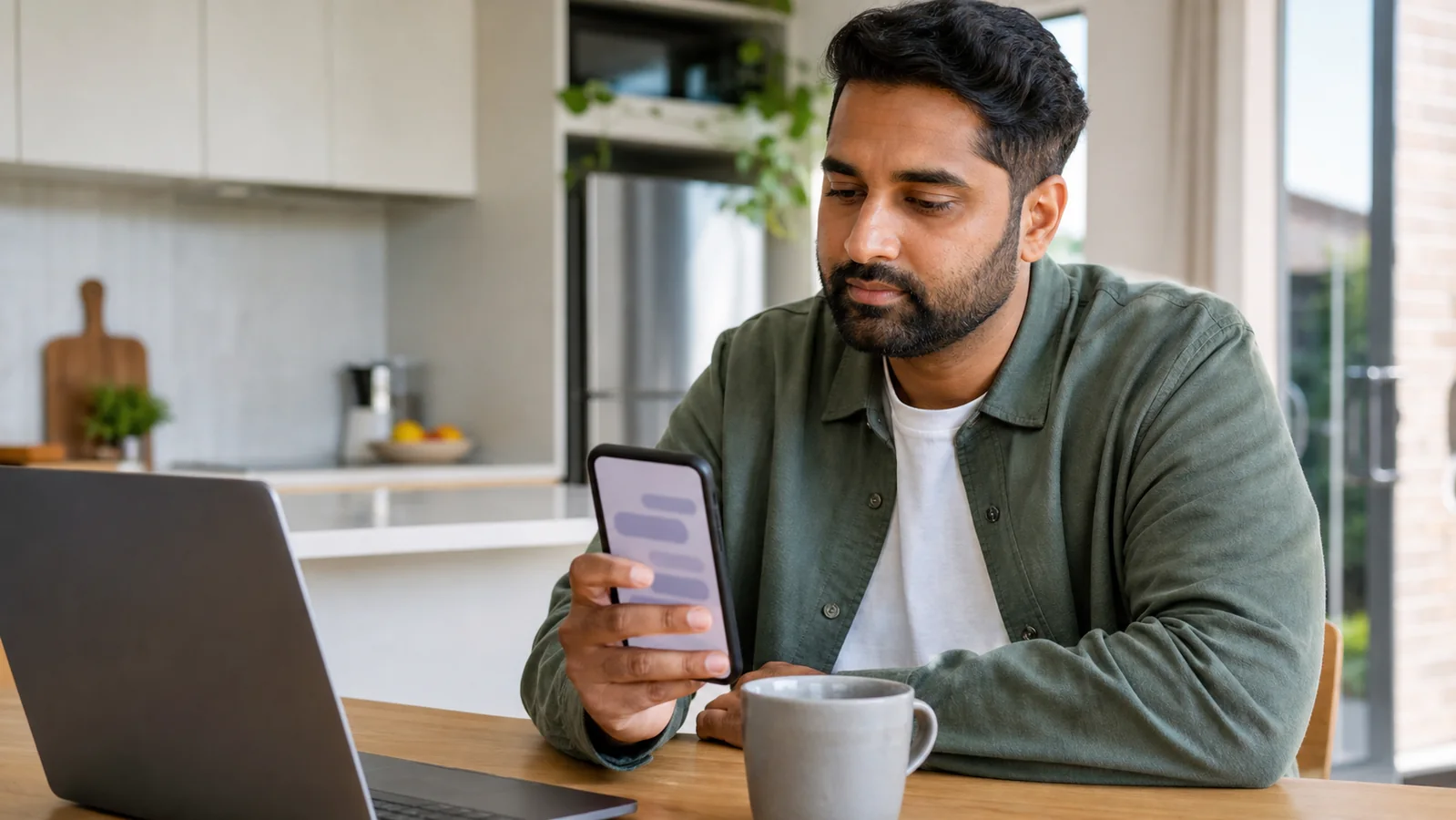
Australian mobile users now have a new warning sign to help them spot suspicious text messages. Since 1 July 2026, texts sent with an unregistered branded sender ID must be labelled “Unverified”—a change that could be particularly useful for Indian Australian families managing banking, myGov, parcel deliveries, medical appointments and visa-related communications across multiple services.
The new national SMS Sender ID Register is designed to make it harder for scammers to impersonate trusted organisations in text messages. But it is not a complete scam filter. An “Unverified” message may come from a legitimate organisation that has not yet registered, while a familiar sender name should never be treated as proof that every request is safe.
What has changed on Australian phones?
A sender ID is the name shown at the top of a business or government text message instead of a mobile number—for example, the name of a bank, delivery company or government service.
Under the new system, registered sender IDs can continue to display the organisation’s name. The Australian Communications and Media Authority (ACMA) says texts using unregistered sender IDs must instead be marked “Unverified” by the telco carrier. Those messages may also be grouped into a single “Unverified” conversation thread on the phone.
This matters because criminals have previously been able to make fraudulent texts appear under the same branded name, and sometimes in the same message thread, as genuine communications. ACMA reports that Australians lost more than $13.8 million to text-message scams in the first nine months of 2025.
Does ‘Unverified’ automatically mean scam?
No. ACMA says an “Unverified” text could be a scam, but it could also be from a genuine business or community organisation that has not completed sender-ID registration.
The label should therefore be treated as a prompt to pause—not as a final verdict. Do not click a link, reply, call a number supplied in the message or provide personal information until you have checked the communication independently.
This is relevant to Indian Australians who may receive texts concerning:
- myGov, Medicare or Australian Taxation Office accounts;
- banks, remittance providers and payment services;
- parcel deliveries from Australia or overseas;
- medical, childcare or school appointments;
- mobile and energy accounts;
- jobs, rental properties or migration services; and
- local associations, temples, gurdwaras, mosques or community events.
Smaller organisations may take time to register their sender IDs, so caution and independent verification are more useful than simply deleting every labelled message.
A five-step check before you act
1. Leave the message closed
Do not use its link, phone number or login button. A polished message, correct logo or urgent language does not make it genuine.
2. Open the service independently
Use the organisation’s official app, type its known web address yourself, or find its public contact number through an independent search. For myGov, open the official app or enter my.gov.au directly rather than following an SMS link.
3. Check whether the request makes sense
Be cautious if the text demands an immediate payment, says your parcel or account will be blocked, asks for a password or security code, promises an easy job, or pressures you to transfer money.
4. Confirm family requests another way
If someone claiming to be a relative says they have a new number or urgently need money, call the number you already have. Ask a question only the real person would know. Families communicating between Australia and India should agree on a simple verification method before an emergency occurs.
5. Protect accounts quickly if you responded
Contact your bank immediately if money or card details may be at risk. Change affected passwords, beginning with email and banking accounts, and enable multi-factor authentication where available.
What a familiar sender name does—and does not—prove
Registration is an important extra layer, not permission to switch off your judgement. Consumers should still be wary of unexpected links and requests for credentials, identification documents, one-time passwords or transfers.
Scamwatch advises people to navigate to the organisation’s secure app or website themselves and to call back using a number found independently. That remains good practice whether a text says “Unverified” or displays a recognised brand.
Where to report and get help
If you believe you have been targeted, report the incident through Scamwatch. For cybercrime such as account compromise or identity misuse, use ReportCyber at cyber.gov.au. If money has been sent, contact your bank immediately.
Free identity and cyber support is available from IDCARE on 1800 595 160. Call Emergency 000 if there is an immediate threat, or the Police Assistance Line on 131 444 for non-urgent police assistance.
The practical takeaway for Indian community Australia households is simple: “Unverified” means stop and check, while a known sender name still requires common sense. Use official apps and independently sourced contact details, and make scam verification a routine family conversation.
Sources: Australian Communications and Media Authority, “SMS Sender ID Register goes live to help protect Australians from scams” (1 July 2026); ACMA, “About the register” (updated 20 July 2026); and Scamwatch, “Text or SMS scams”.