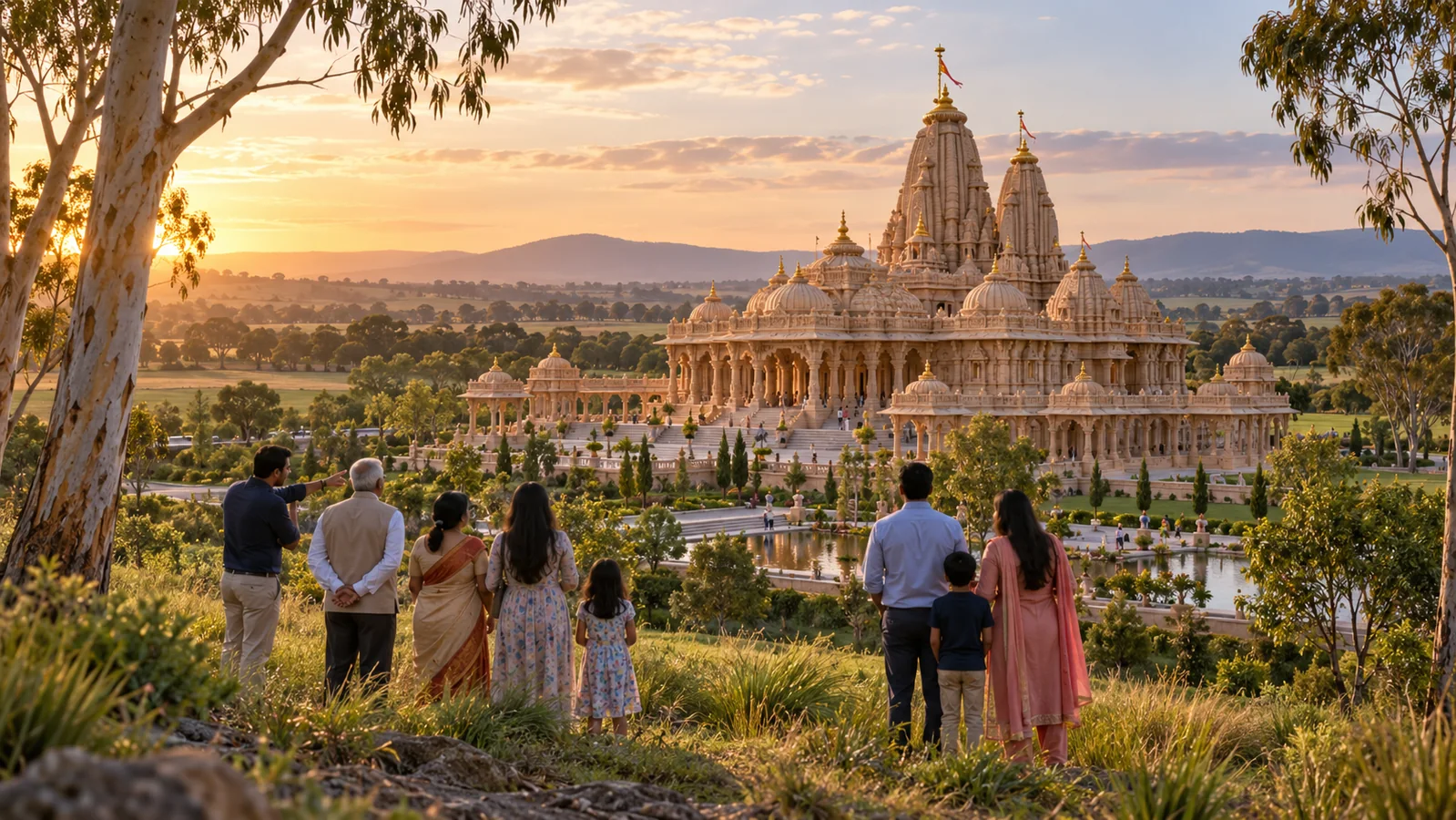
A proposed $209 million Hindu Mahā-Mandir in Melbourne’s south-east could become the largest Hindu temple in Australia if it receives planning approval. The ambitious Cranbourne South project promises a major spiritual and cultural centre for a fast-growing Indian-Australian community, but it has also prompted concerns about traffic, vegetation and development within a protected green-wedge area.
The proposal is significant well beyond its architectural scale. Around one in 10 City of Casey residents identifies as having Indian ancestry, according to figures cited in ABC News reporting. The debate therefore raises a practical question facing many growth corridors: how should governments provide space for places of worship while also protecting environmental and agricultural land?
What has been proposed?
Bochasanwasi Shri Akshar Purushottam Swaminarayan Sanstha Australia Ltd, commonly known as BAPS, has lodged an application for a Mahā-Mandir place of worship on the Western Port Highway at Cranbourne South.
According to details reported from the application and its economic assessment, the proposal includes:
- a development valued at approximately $209 million;
- a temple building reaching about 64 metres in height;
- up to 1,200 visitors on a typical weekday;
- larger special events, attracting roughly three times the usual weekday attendance, up to nine times a year;
- an estimated 143 ongoing jobs; and
- a projected contribution of more than $12 million annually to Victoria’s economy.
Supporters say the project would provide culturally appropriate infrastructure for local Hindu communities and could become a pilgrimage and tourism destination. BAPS volunteer Yash Patel told the ABC that the organisation wanted the Mahā-Mandir to be a spiritual home for Australian Hindus and a welcoming place where people from all backgrounds could visit, learn and connect.
Why has the City of Casey objected?
The proposed site lies in the Western Port Green Wedge, outside Melbourne’s Urban Growth Boundary. Green wedges are intended to protect agriculture, biodiversity, landscapes and open space while generally supporting lower-density uses.
The City of Casey has issued a statement about the application and lodged an objection after assessing it against planning requirements. Concerns identified by the council include:
- pressure on the local traffic and road network;
- vegetation removal and possible effects on wildlife;
- noise, lighting and visual impacts for nearby residents; and
- whether the scale and use are consistent with the planning objectives of the Western Port Green Wedge.
Local green-wedge advocates and a residents’ group have also raised concerns about the building’s scale and whether surrounding infrastructure can accommodate the expected visitor numbers. Importantly, these objections relate to land use, environmental protection and infrastructure capacity; they do not amount to a final refusal of the project.
Who will make the final decision?
The planning decision will not be made by the City of Casey. Because of the project’s stated economic value, the application was lodged through the Victorian Government’s Development Facilitation Program, a pathway intended to accelerate decisions on significant developments.
That means Victoria’s planning minister has decision-making authority. The proposal went through public notice in September, and the state government has said it will assess the application on its merits. At the time of publication, the temple remains a proposal and has not been finally approved.
Why the debate matters to Indian Australians
Melbourne’s outer south-east has experienced rapid population growth, including strong growth in Indian and Hindu communities. Temples and community centres can support worship, festivals, language, volunteering, youth activities and social connection, particularly for newly arrived families and older migrants.
However, fast-growing suburbs also need roads, public transport, parking and appropriately zoned community land. When suitable sites are scarce, faith organisations can find themselves pursuing large projects in areas where planning policy seeks to limit urban-style development.
The Cranbourne South proposal therefore highlights a broader planning challenge: cultural infrastructure needs to be considered early as suburbs expand, rather than treated as an afterthought once communities are already established.
What happens next?
Indian Australians interested in the project should distinguish between the cultural case for a major Hindu centre and the technical planning questions surrounding this particular site. Both deserve a fair, evidence-based hearing.
The planning minister will consider the application, relevant expert reports, public submissions and objections before reaching a decision. Until then, claims that the temple is certain to be built—or has already been rejected—would be premature.
For the wider community, the constructive takeaway is clear: Victoria needs long-term planning that protects green wedges while ensuring multicultural growth areas have suitable, well-serviced land for places of worship and community life.